
This Is Your Club. Your Voice Matters.
August 3, 2026
Archery Club News | August 2026
August 3, 2026
There are many existing threats right now that could get worse or could improve, often depending on whether or not people act. I want to write this month a little bit about invasive species and why we should care.
In general, the definition of an “invasive” species is one that satisfies two criteria – it is not native to the area and it causes harm. That “causes harm” part is the reason we should care.
Let’s take, for example, phragmites (frag-MYteez) If you don’t know what I’m talking about, trust me, you’ve seen them. They are the tall reeds that line roadways, ditches, shorelines, marshes, and even racetracks. That last reference is, of course, about our own club property, where phragmites management has now become required for safety.
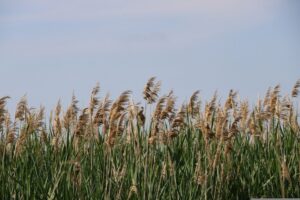 The state of Michigan website says phragmites can grow to be 15 feet tall, and many other references say they can grow to 20 feet tall. They will overtake a cattail marsh in just a few years. This causes a reduction in fish and wildlife populations. The native critters have essentially lost their habitat. A marsh dense with phragmites is very homogeneous. There is little else in the marsh except these towering reeds. They also disrupt picturesque views and are a fire hazard.
I like to call them “those phrag dagmites.”
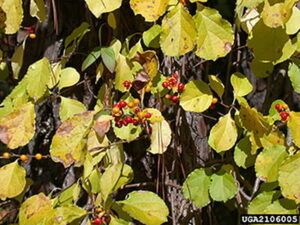 We also have issues at the club with an invasive vine known as Oriental Bittersweet. You folks at the archery club are especially familiar with this one. This invasive vine can grow to 60 feet and kills trees by “girdling” or strangling trees as well as by blocking sunlight. I’ve learned that trimming these vines without treating the cut portions can make the problem worse, as it actually facilitates propagation rather than stopping it.
Eradication of these invasive plants in localized areas is possible, but it requires a great deal of effort. Physical labor must be expended over multiple seasons. Herbicides and prescribed burns may need to be employed.
There are plenty of resources available to learn more about invasive species in Michigan. The Michigan DNR website has loads of info. Go to Michigan.gov/DNR and search for “invasive species.” I am in the early stages of discussions with Oakland County’s Cooperative Invasive Species Management Area (CISMA) coordinator (meaning, I sent an email). I intend to discuss assessing club property to determine actions we can take to eradicate these invasives.
While I’m at it, I would like to give a solid endorsement to the Michigan DNR’s “Wild Talk” podcast. It comes out very punctually on the first of every month and is always great. They cover a wide variety of topics regarding conservation, various species of wildlife that live in Michigan, and current projects being undertaken by the DNR. Search for “Michigan DNR Wild Talk podcast.”
So, what are your thoughts regarding invasive species, especially on club property? Please contact me with your thoughts. And finally, don’t forget to vote on August 4th.
Dave Budnick – Director, Conservation Advocacy
Oakland County Sportsmen’s Club
(248) 978-3454
davebudnick@comcast.net
davebudnick.com