
Parliamentarian’s Corner
November 2, 2026
Archery Club News – October / November 2026
November 2, 2026

The Double-Crested Cormorant is a dark colored, medium-sized waterbird found throughout North America. Cormorants of other types are found throughout the world. Many people say they look somewhat prehistoric.
You often see them perched in trees or on boat docks with their wings spread wide to dry them. Areas with the some of t he highest popu lation densities of cormorants are on our Great Lakes and Lake St. Clair. A bit of a fight has been underway recently regarding cormorants on Dog Island just off of Lake St. Clair Metropark.
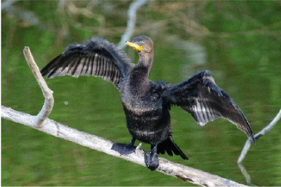 Cormorants nest in colonies and that can mean hundreds of birds nesting in a relatively small area. Their droppings are highly acidic and kill vegetation around the breedi ng colonies, and even the trees in which they are nesting. Cormorants eat about one pound of fish per day. A population of thousands living and feeding in one area can affect fish populations in that area. The true impact to sport fisheries is probably not known to a precise level of detail, but it doesn’t seem too fa r-fetched to think t hey can have an impact . The flip side of that coin is that Lake St. Clair remains one of the world ‘s preeminent fisheries for walleye, perch, small mouth bass, and many other highly sought after gamefish. So is the cormorant population affecting fish populations or not? Many homeowners complain about the “nuisance” caused by cormorants. There is the smell, the “unsightly” dead trees and vegetation, and even the noise they make. Over the past few months, people near Lake St. Clair have begun to organize around the issue in an attempt to take action. Protesters have been showing up at viewing sites with signs primarily in opposition to lethal controls to reduce t he population.
One issue with population reduction is that cormorants are a migratory species and as such, protected by the Migratory Bird Treaty Act (MBTA). This the same treaty under which allowable take is determined each year for our waterfowl hunting seasons. Control of cormorant populations falls under the auspices of the U.S. Fish and
Wildlife Service. It is not at all uncommon for USFWS to issue cormorant control permits, but keeping with the spirit of MBTA, it is an arduous process to get a permit and legitimate rationale with rigorous study must occur to get a permit. Recent legislation in the U.S. congress has been proposed to make it easier for state agencies to issue permits without the involvement of USFWS. The legislation, introduced by a Michigan congressman, received unanimous support in committee. A vote of the full house is pending.
I find this an interesting conservation dilemma and frankly, I don’t have a strong opinion on one side or the other. The thing that makes decision-making on this issue easier is that populations of cormorants are very healthy. That means getting rid of the small population on Dog Island won’t hurt the overall population at all.
On the other hand, those cormorants are just doing what they’ve done for millennia. They’ll just leave and nest elsewhere, maybe in your backyard! What do you think? Please let me know.
Conservation organization affiliations – Please join us at the club on Tuesday, November 10, 2026, at 7pm when will discuss potential affiliations between OCSC and various conservation organizations.
And if you’re reading this before November 3rd , don’t forget to vote!